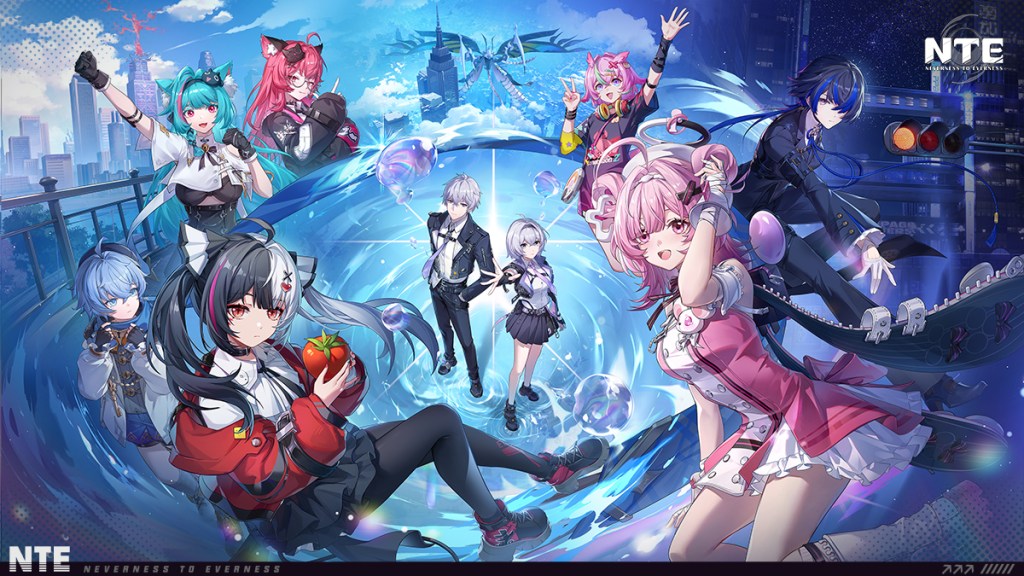
Not your average gacha. (Image Credits: Studio Hotta)
A Whole New World
I’ll be honest. The first time I heard about Neverness to Everness was because I mistook it for Project Ananta (which I’m still waiting for). Neverness to Everness, or NTE as I will refer to it from here on out, is the newest of many open world gacha games to hit the market. From a surface perspective, especially to many that don’t play gacha games, they may all look the same, and I wouldn’t blame you if you held that opinion. NTE follows the same formulas as many of the big gacha games on the market right now, but to great efficacy.
Industry and Experience
Firstly I’d like to talk about the game’s impact on the industry and its relevancy. I believe that before you put your time into anything you should think about why it’s deserving of your time and if it is innovative in some capacity or if it just exists as slop that will have an EoS in two years and will consume your hard-earned money. NTE is a game that noticeably has taken the best aspects of its forefathers and blends it into a cohesive experience. It takes the combat style of Wuthering Waves and the open world and feel of Genshin Impact. It retains an impressive degree of “aliveness” to its world that may feel akin to Genshin, but set in a decidedly more urban setting to change things up. The presence of hostile anomalies (which are SCP-like creatures that inhabit the world) make Hethereau City feel like a happier version of The City from Limbus Company. Lastly, the explorable area at the moment is small, but densely packed and very vertical. One could say that it’s akin to something like the Yakuza series, where the maps are relatively small compared to something like GTA but the buildings have many floors and different attractions. Further developments will likely expand the map; I expect the map to reach a size rivaling a Saints Row game soon and then GTA or Wuthering Waves in the years to come. The map isn’t exactly small either–traversing it on foot in search of POIs will take considerably longer than if you drive your car.
Speaking of attractions, I mentioned that the world feels alive–that’s not just due to the presence of NPCs both on the road and on the sidewalks. The cities have storefronts back-to-back that you can actually buy from and interact with; even the suburban areas have beautiful vistas to go sightsee at. The game comes with a first-person mode as well so that you can really just walk slowly and take in the atmosphere. Coupled with collectibles scattered and hidden throughout the map, you will often find yourself heading to a mission objective and then wandering off all the way to the other side of the map. There are just so many things to do in the city and so many ways to do them; you can make money in a variety of different ways depending on what you’re interested in doing. The world has a degree of attention to detail that feels almost too good to be true–it makes me wonder how much the game cost to produce given how minute some of these details are, often to the point that one would simply pass them by if running somewhere in a hurry.
Gameplay
The gameplay is certainly flashy, but as of version 1.0 is not yet too complex. Upon starting the game there is a slew of keywords like a character’s type or element, but a few guides will set you straight towards making a solid team. Combat is a little more nuanced than the likes of Genshin or ZZZ, but will not have you thinking on your feet like a traditional CAG like Devil May Cry or Ninja Gaiden. Combos largely still consist of button mashing and the occasional special attack or ultimate while interspersed with dodging; the most thought you will really need to put into the game will be how long to keep certain characters on-field and watching the attack patterns of enemies.
The game has shipped with multiplayer, and while it isn’t quite exactly what people wanted, it’s better than average. Multiplayer offers up to four people to play together, and changes a few aspects of the world to facilitate that such as mob drop sharing, your wanted level not going up, etc. Notably, NTE’s multiplayer allows all players to use their full squads, as opposed to certain other games which may limit multiplayer players to using only one of their characters. There are a few activities you can do together, such as minigames or even some anomaly explorations like the hospital; these are exceptions rather than the rule however and so you should not expect to be able to do all anomaly commissions together. Notably the Pink Paw Heist, one of the best ways to acquire Fons (which are one of the in-game currencies), is able to be played in multiplayer. Given that it’s a frantic race against the clock, having three other buddies to help certainly will shave down time spent exploring all rooms.
Story
The story tends to drag along at times, and it’s something that isn’t helped by the presence of what seems to be an animation bug where dialogue is directly tied to the animation keyframes of each section; at times, even if the dialogue has finished you are stuck waiting for several seconds in silence for the next animation set to load in. Thankfully, if this becomes unbearable there is a skip button. The first two chapters are somewhat slow, but this is to be expected considering they are introductory. The second chapter is somewhat divisive among players due to the central character coming off as annoying and moreover as a massive liar that keeps embroiling others into his schemes, but I did find it enjoyable. A mix of cringy schadenfreude directed at said character and filling in the role as the guy patching up mistakes made it more fun. From then on, the third chapter was a big improvement and I have yet to advance further.
I Love Gambling!
Finally, the gacha portion. The rest of the game is overall great, and it’s worth playing even casually as a free to play player because the game is very generous with free pulls. All of the above activities that I previous described all have challenges and achievements associated that absolutely dump premium currency in your lap. The gacha portion of the game exists through a section in your phone known as the “Scarborough Fair.” Amidst a glitzy gold carnival, you spend your pulls (which are dice) to roll a d6 in order to move your piece across the board and pick up prizes. Any roll has a small chance of getting you the banner character, with rates increasing to a flat 20% once you have reached 70 pulls. Notably, this game does not feature a 50/50 system–at 90 pulls, you get the banner character, no ifs ands or buts. A wonderful system that any veteran gacha player would celebrate. Landing on a gold chest has a boosted chance of granting the banner character. There are other prizes present on the board–landing on an A rank card will give you a random A rank arc or character, and even the S rank characters are present as cards on the board as well, along with other prizes such as their signature glider and a livery featuring them on a vehicle. The act of rolling a die to get your piece moving and being able to see what prizes are ahead of you is what makes this so much more fun; you’re not just mindlessly dumping tickets into a machine, but it feels like you’re really gambling. I think that’s what’s missing from other gacha systems and NTE does it so beautifully. Now don’t get me wrong, I think it’s wholly possible and very easy for the system to rig your rolls so that you don’t land on valuable things so easily. That said, I got the previous banner character, Nanally, at only 21 pulls because I landed directly on her card on the board. Say what you will but I think having that chance at all makes it so much more enticing and fun.
In Conclusion
Dailies are hilariously short and weekly Fons jobs are actually fun to do. This game respects your time. I highly recommend giving this game a try. It is well-made and is very innovative.
I am not sponsored by Studio Hotta; I hope you enjoy the game as much as I do and please spend responsibly.



Leave a Reply